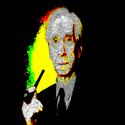
Bertrand Russell
Full Name and Common Aliases
Full Name: Bertrand Arthur William Russell
Common Aliases: Bertrand Russell
Birth and Death Dates
Born: May 18, 1872
Died: February 2, 1970
Nationality and Profession(s)
Nationality: British
Professions: Philosopher, Logician, Mathematician, Historian, Social Critic, Political Activist
Early Life and Background
Bertrand Russell was born into an aristocratic family in Trellech, Monmouthshire, Wales. His early life was marked by tragedy, as he lost both parents and his sister by the age of six. Raised by his grandparents, Russell was educated at home by tutors, which fostered his early love for mathematics and philosophy. His grandfather, Lord John Russell, had been a Prime Minister of the United Kingdom, which instilled in him a deep understanding of political affairs from a young age. Russell's education continued at Trinity College, Cambridge, where he excelled in mathematics and philosophy, laying the groundwork for his future intellectual pursuits.
Major Accomplishments
Bertrand Russell's contributions to philosophy and logic are monumental. He is best known for his work in analytical philosophy and his role in the development of modern logic. Alongside Alfred North Whitehead, he co-authored the seminal work Principia Mathematica, which sought to ground mathematics in logical foundations. This work was pivotal in the development of logicism, a philosophical belief that mathematics can be derived from logical axioms.
Russell was also a prominent social critic and political activist. He was an outspoken pacifist during World War I, which led to his imprisonment. His advocacy for nuclear disarmament and his opposition to totalitarianism in all forms were central to his public life. In 1950, he was awarded the Nobel Prize in Literature, not for his philosophical works, but for his varied and significant writings championing humanitarian ideals and freedom of thought.
Notable Works or Actions
Among Russell's numerous writings, The Problems of Philosophy and A History of Western Philosophy stand out as accessible introductions to philosophical thought. His essay "On Denoting" is considered a cornerstone in the philosophy of language. Russell's activism is equally notable; he was a leading figure in the Campaign for Nuclear Disarmament and a vocal critic of the Vietnam War. His public lectures and debates, such as those with Father Frederick Copleston, showcased his ability to engage with complex ideas in a manner that was both rigorous and accessible to the general public.
Impact and Legacy
Bertrand Russell's impact on philosophy, logic, and social thought is profound and enduring. His work laid the foundation for much of contemporary analytic philosophy and influenced a wide range of disciplines, from mathematics to cognitive science. His advocacy for peace and social justice inspired generations of activists and thinkers. Russell's ability to communicate complex ideas to a broad audience helped demystify philosophy and made it more accessible to the public.
His legacy is also marked by his commitment to rational inquiry and skepticism, which challenged dogmatic beliefs and encouraged critical thinking. Russell's influence extends beyond academia; his ideas continue to resonate in discussions about ethics, politics, and the role of science in society.
Why They Are Widely Quoted or Remembered
Bertrand Russell is widely quoted and remembered for his incisive wit, clarity of thought, and moral courage. His quotes often reflect his deep commitment to reason, skepticism, and humanism. Pithy and profound, his words capture the essence of complex philosophical ideas in a manner that is both thought-provoking and accessible. Russell's ability to distill intricate concepts into memorable aphorisms has ensured that his insights remain relevant and influential.
His life and work exemplify the power of intellectual rigor combined with a passionate commitment to social justice. Russell's legacy as a thinker and activist continues to inspire those who seek to understand the world and improve it through reasoned discourse and compassionate action.
Quotes by Bertrand Russell
Bertrand Russell's insights on:

Advocates of capitalism are very apt to appeal to the sacred principles of liberty, which are embodied in one maxim. The fortunate must not be restrained in the exercise of tyranny over the unfortunate.


Against my will, in the course of my travels, the belief that everything worth knowing was known at Cambridge gradually wore off. In this respect, my travels were very useful to me.

I like mathematics because it is not human and has nothing particular to do with this planet or with the whole accidental universe— because, like Spinoza's God, it won't love us in return.

Boys and girls should be taught respect for each others liberty, and that jealousy and possessiveness kill love.

Love of power, in its widest sense, is the desire to be able to produce intended effects upon the outer world, whethen human or non-human.

If one man offers you democracy and another offers you a bag of grain, at what stage of starvation will you prefer the grain to vote?

There is power over human beings and power over dead matter or non-human forms of life.

Language serves not only to express thoughts but to make possible thoughts that could not exist without it.

The power impulse has two forms: explicit, in leaders; implicit in their followers. When men willingly follow a leader, they do so with a view to the acquisition of power by the group which he commands, and they feel that his triumphs are theirs.